
Spain’s Medical Technology Sector Invests €344 Million in R&D&I, Records a 94% Increase in Patent Applications Over the Past Decade and Leads in Securing EU Funding
.
- The Spanish Federation of Healthcare Technology Companies (Fenin) presents its report, “Analysis of R&D&I Capabilities in the Medical Technology Sector in Spain”, during a media event held in Córdoba.
.
- Medical Technology companies have the highest R&D intensity relative to turnover (7%) among industrial sectors in Spain, with 38% of companies operating an R&D center. However, despite this “scientific and technological excellence”, there is still room for improvement in the commercialization, protection and adoption of innovation within the healthcare system.
.
- The sector calls for legislative and economic measures to accelerate access to innovative technologies and ensure business competitiveness, including Innovation Procurement, the indexation of public contracts to the Consumer Price Index (CPI) and a dedicated Industrialization Plan.
.
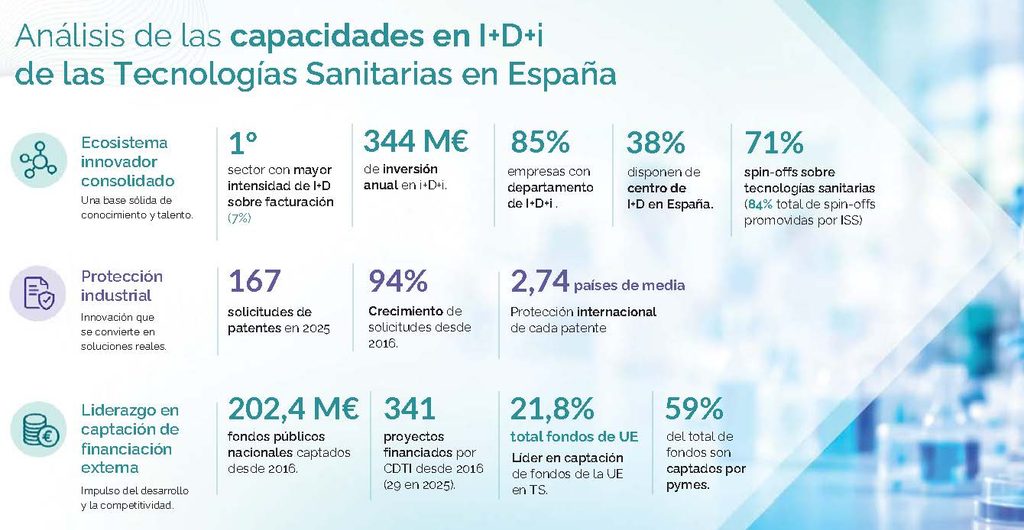
Medical Technology companies in Spain invest more than €344 million annually in research, development and innovation (R&D&I), making the sector the most R&D-intensive relative to turnover (7%) among Spain’s industrial sectors. This commitment to innovation has driven a 94% increase in medical technology patent applications over the past decade, rising from 86 in 2016 to a record 167 applications in 2025. Beyond their own investment, companies in the sector demonstrate a strong capacity to secure competitive funding at both national and European levels. Spain leads Europe in securing EU funding for medical technologies, accounting for 21.8% of the total funding allocated by the European Union.
.
These findings are presented in the “Analysis of R&D&I Capabilities in the Medical Technology Sector in Spain” report, presented by Pablo Crespo, Secretary General of the Spanish Federation of Healthcare Technology Companies (Fenin), during the 2026 Journalists’ Seminar, held in Córdoba on September 15–16. The event also provided an opportunity to discuss the sector’s proposals for further strengthening Spain’s medical technology innovation ecosystem and enhancing business competitiveness amid a challenging geopolitical and industrial environment, ahead of Spain’s 2027 electoral year.
.
Pablo Crespo stated that the figures “demonstrate the sector’s leadership in innovation and its excellent international positioning, both of which are essential to helping our healthcare system deliver more precise, personalized and efficient care, while establishing the industry as a driver of economic and social progress in Spain.” Fenin’s Secretary General also highlighted that the Medical Technology industry already contributes more than €6 billion to Spain’s GDP and has the potential to increase this contribution. However, he stressed that “the current regulatory framework must be adapted to improve the sector’s competitiveness, through measures such as the indexation of public healthcare contracts and the swift adoption of innovation.”
.
R&D&I, Entrepreneurship and Internationalization
Alongside its combined annual investment of €344 million in R&D&I, 85% of Medical Technology companies have a dedicated R&D&I department, while 38% operate an R&D center in Spain. The report also highlights the increasing maturity and significant technological diversification of Spain’s startup ecosystem, as well as the existence of 71 medical technology-related spin-offs, representing 84% of all spin-offs established by Spain’s Health Research Institutes.
.
 .
.Research capabilities demonstrate a high degree of specialization and alignment with major healthcare challenges and national and European R&D&I policy priorities. Key areas include oncology, neuroscience, infectious diseases, personalized medicine, artificial intelligence, digital health, bioengineering and photonics, among others.
.
In terms of national funding, the report underlines the industry’s ability to compete, collaborate and lead high-impact projects. Over the past decade, companies have secured €202.4 million in public funding, with a total of 341 sector-specific R&D&I projects supported by the Centre for the Development of Industrial Technology (CDTI), including 29 projects in 2025. Notably, small and medium-sized enterprises (SMEs) have secured 59% of the total funding.
.
From a regional perspective, the analysis identifies a concentration of innovation activity in established technology hubs, particularly Catalonia and the Community of Madrid, where innovation ecosystems are more mature. The report therefore calls for proactive policies in other Spanish autonomous communities to strengthen knowledge transfer, develop sector-specific entrepreneurship and incubation programs, and introduce tax incentives to attract investment.
.
The protection of R&D&I outcomes has followed an upward trend since 2016, reaching a record 167 patent applications in 2025. Nevertheless, there remains considerable scope for improvement compared with Europe’s leading countries. One of the main challenges identified is the limited international protection of inventions originating in Spain: on average, each technological innovation developed in Spain is protected in just 2.74 countries. This is partly attributed to the difficulties companies face in covering the substantial costs associated with broad international patent protection. To address this challenge, the report recommends establishing a national strategy for the international protection and commercialization of R&D&I, alongside dedicated funding mechanisms to support the international extension of patents.
.
Promoting Innovation Procurement
The report concludes that Spain’s Medical Technology Sector has a strong capacity to generate knowledge, attract competitive funding, develop innovative technologies, create new businesses and attract investment in areas of strategic importance to the healthcare system. However, despite this “scientific and technological excellence”, significant opportunities remain to improve the commercialization and protection of innovation, as well as its integration into the healthcare system.
.
The report calls for legislative and economic measures to accelerate the transfer of technological innovation to the market and its adoption by the healthcare system. A key recommendation is the promotion of Innovation Procurement, identified as a “strategic tool” to facilitate the early adoption of new solutions in clinical practice, improve healthcare system efficiency, reduce uncertainty associated with innovation and strengthen the business ecosystem.
.
In addition to the measures outlined in the report, Fenin has put forward further proposals to public authorities and political parties to improve access to innovation and strengthen business competitiveness. These include developing a dedicated regulatory framework for medical technologies and medical devices, indexing public contracts to the Consumer Price Index (CPI), and implementing an Industrialization Plan for the Medical Technology Sector.
.
Visit to Reina Sofía University Hospital in Córdoba
As part of the seminar, journalists visited Reina Sofía University Hospital in Córdoba, which celebrates its 50th anniversary this year, to gain first-hand insight into how medical technology is transforming surgical care and the hospital’s commitment to high-complexity surgery, robotics, smart operating rooms and the integration of innovation into clinical practice.
.
Francisco Triviño, Managing Director of the hospital, stated: “Medical technology is now an indispensable ally in our efforts to continue improving quality, precision and safety. The challenge is not simply to introduce new equipment, but to integrate innovation throughout the entire care pathway, from preoperative planning to the surgical procedure itself. Robotic surgery, smart operating rooms, navigation systems and 3D printing allow us to anticipate challenges, assess each case in greater detail and undertake highly complex procedures while minimizing risks to patients.”
.
Javier Briceño, Head of General Surgery, presented the evolution of medical technology in the operating room, from minimally invasive surgery to the introduction of robotics, smart operating rooms and hybrid operating rooms. The hospital has firmly established robotic surgery within its clinical practice and has progressively expanded its applications to increasingly complex procedures.
.
The visit also offered an opportunity to learn about the work of the hospital’s Innovation Unit, which focuses on translating new technological solutions into clinical practice. Its activities center on identifying needs arising directly from the clinical environment and working alongside healthcare professionals, researchers and technology specialists to develop tools that improve healthcare processes and deliver greater value to patients.