
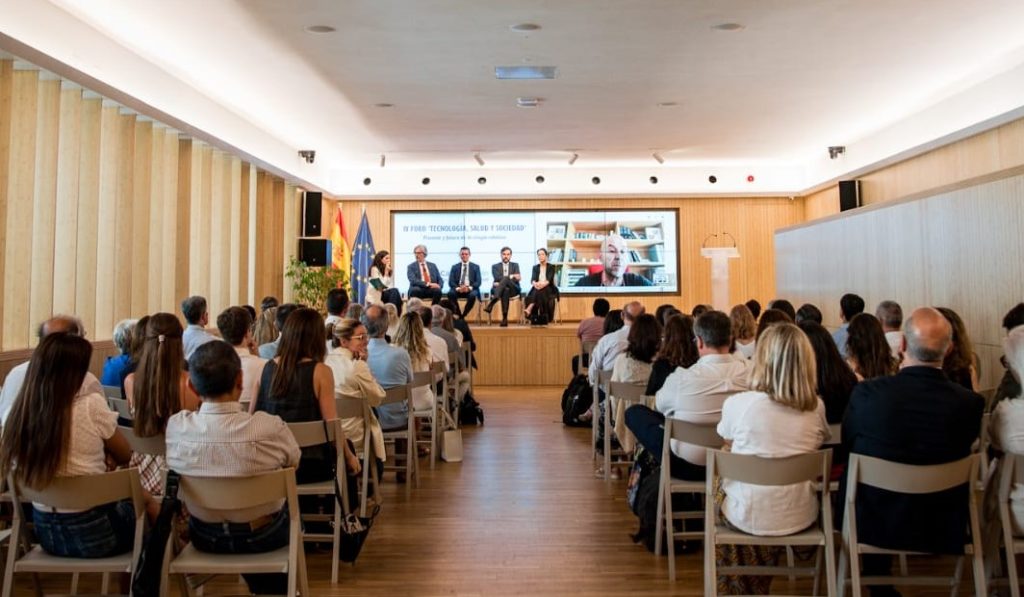
At the 4th Technology, Health and Society Forum, organised by the Fenin Chair in Technology and Health—an initiative promoted by the Spanish Federation of Healthcare Technology Companies, Fenin, the Fenin Foundation and the Ortega-Marañón Foundation—hospital managers, Heads of Department and industry representatives discussed the presence of this technology within the healthcare system.
.
Robotic surgery has become firmly established as a relevant technology whose implementation continues to grow, although access and use remain uneven. According to the experts, its impact largely depends on the clinical indication, the experience of the surgical team and the organisation of the care pathway. Structured training and accreditation are also essential to ensuring safety and generating value in robotic surgery.
.
Robotic surgery has become established as a significant technological innovation within Spain’s National Health System (SNS), with increasing implementation in operating theatres and across multiple medical specialties due to the improved outcomes it can offer patients. Although it is now a well-established and expanding technology, variations in access and use remain, with implications for equity, quality and the efficiency of healthcare delivery.
.
These were among the reflections shared by hospital managers, Heads of Department and representatives of the Healthcare Technology industry at the 4th Technology, Health and Society Forum. Entitled “The Present and Future of Robotic Surgery”, the event was held in Madrid and organised by the Fenin Chair in Technology and Health, promoted by the Spanish Federation of Healthcare Technology Companies, Fenin, the Fenin Foundation and the Ortega-Marañón Foundation.
.
During the opening session, Professor Fernando Bandrés, President of the Fenin Foundation, stated:
“Robotic surgery is a technology with the potential to improve certain clinical and organisational outcomes, particularly in more complex settings. However, its value is neither uniform nor inherent to the technology itself; it depends on its integration into appropriate healthcare models. Through this forum, we aim to promote a present- and future-oriented approach to robotic surgery based on value, prioritising evaluation, organisation and the sustainability of healthcare organisations.”
.
Lucía Sala, Director General of the Ortega-Marañón Foundation, said:
“The Fenin Chair in Technology and Health is an exceptional instrument for promoting innovation within Spain’s National Health System from the perspective of patients and healthcare professionals. Robotic surgery will improve the lives of many people and, for this reason, it deserves particular attention from knowledge and research institutions.”
.
During the event, Miriam Toca, Coordinator of Fenin’s Robotics Group, presented the preliminary findings of a report promoted by the Fenin Chair. The report analyses the clinical impact, efficiency and value generated by robotic surgery for patients and Spain’s National Health System and will soon be made available to the entire healthcare ecosystem.
“The available evidence shows that, compared with open surgery, robotic surgery can reduce surgical trauma and blood loss, support faster patient recovery in certain procedures, and maintain or improve clinical outcomes in highly technically complex cases. Its impact depends largely on the clinical indication, the experience of the team using the technology and the organisation of the care pathway,” Miriam Toca explained, referring to the report’s preliminary conclusions.
.
Regarding its implementation within the SNS, the introduction of robotic surgery entails significant organisational changes to healthcare models. These include establishing coordinated care structures, adapting operating theatre processes, developing new professional skills and systematically measuring outcomes.
.
Value-based robotic surgery programmes
As part of the presentation, a panel discussion was held with the report’s authors: José M. Balibrea, Head of the General and Digestive Surgery Department at Germans Trias i Pujol University Hospital in Badalona; Nicolás Moreno, Head of the Thoracic Surgery Department at Ramón y Cajal University Hospital in Madrid; Víctor Díez Nicolás, Head of the Urology Department at Quirónsalud Madrid University Hospital; David Noriega, Head of the Traumatology and Orthopaedic Surgery Department at Valladolid University Clinical Hospital; and Berta Díaz-Feijoo, Head of the Gynaecology Department at Hospital Clínic Barcelona.
.
The experts examined the organisational and healthcare implications of implementing robotic surgery programmes within their departments and discussed how to maximise the value generated by these programmes.
.
Among other factors, the experts highlighted the need to develop official professional certification programmes and accreditation schemes for robotic surgery units, standardise procedures and promote training programmes involving not only technology providers but also hospitals, scientific societies, universities, public authorities and other relevant stakeholders.

What does the implementation of a robotic surgery programme mean for hospital management teams? What criteria should be considered, and what barriers arise when acquiring this equipment?
.
These issues were discussed by Carlos Mingo, Managing Director of Ramón y Cajal University Hospital in Madrid, and José Antonio Arranz, Managing Director of Valladolid University Clinical Hospital. Both advocated for the adoption of value-based innovation and for integrating this innovation into well-established healthcare and organisational processes.
.
The ultimate objective is to ensure that robotic surgery is used efficiently, safely and equitably.